

AI offers numerous opportunities to enhance our work. Many faculty and staff at UGA across various units have embraced AI tools through exploration and/or pilots for work enhancement.  One example of this is the use of the Whisper tool pilot being used to transcribe audio at the UGA Libraries’ Brown Media Library. Others are using UGA provided tools CoPilot, Gemini and NotebookLM for assistance with queries, editing and data processing.

Resources for staff

AI Literacy Initiative
UGA is offering a campus-wide course, “AI Literacy for All” offered by the Digital Education Council, designed to provide students, faculty and staff with a foundational understanding of artificial intelligence. This course emphasizes responsible use and explores the implications of generative AI in both academic and professional settings. It will serve as a shared baseline resource to support a common understanding of AI across the university community.

UGA’s AI tools for faculty, staff, and students:

Use your UGA MyID ([email protected]) account when accessing institutionally supported tools. Access to a supported tool does not authorize the use of sensitive or restricted UGA data. Faculty must follow the UGA Data Classification and Protection Standard and any tool-specific data-handling guidance.

LinkedIn Learning AI courses 

What You Need to Know about ChatGPT
from the Chronicle of Higher Education 


Policy & Guidance

UGA Policy on the Use of Artificial Intelligence in Academic and Operational Contexts

USG Board of Regents Policy on Artificial Intelligence in Academic Contexts

UGA Guidance on Acceptable Use of AI 

USG Artificial Intelligance Guidelines 

UGA Information Technology Policy – Data Classification and Protection Standard

UGA Research Data Stewardship Policy and related guidance
Sensitive Data Use 

Frequently Asked Questions

Can I use AI to draft university emails, reports, or website content?  +

AI can assist in drafting, but human oversight is essential to ensure accuracy, tone, and compliance with university branding and privacy policies. Always fact check the accuracy of AI’s outputs and follow our UGA data policies when using AI applications. 

How can I protect data and privacy when using AI tools?   +

To ensure data privacy, use only the UGA approved tools using your UGA login or discuss setup of local tools with your departmental IT and/or EITS.  

How is UGA using AI to improve campus operations and services?  +

UGA is exploring AI to enhance administrative efficiency, student services, and campus safety. Examples include AI-driven chatbots for admissions and advising, predictive analytics for enrollment management, and smart systems for facilities and energy use. These efforts are guided by UGA’s commitment to ethical and transparent AI use.

What AI tools are available to staff for administrative or support tasks?  +

Staff have access to numerous tools through UGA EITS.  A current list of supported tools can be found here

How can AI be used to enhance productivity and efficiency in the workplace?  +

AI can automate repetitive tasks, streamline data entry, generate reports, and assist with scheduling. For example, staff can use AI to analyze survey data or create content drafts or outlines. Training is available to help staff adopt these tools effectively through LinkedIn Learning.

What training is available for UGA employees to learn about AI?   +

UGA offers professional development through Training & Development and the CTL, including workshops on digital tools, data literacy, and AI basics. Online modules and webinars are also available for self-paced learning.The UGA Libraries also offer classes and resources on AI literacy 

Are there policies at UGA regarding the ethical use of AI in the workplace?   +

Yes. UGA follows general data governance and privacy policies, and departments are encouraged to develop guidelines for responsible AI use. Staff should avoid using AI tools that store sensitive data externally and should consult with EITS or Legal Affairs when in doubt. 

How can AI support decision-making and data analysis in my department?   +

AI can help identify trends, forecast outcomes, and visualize data. Tools like Power BI, Excel with Copilot, Gemini and Tableau (if licensed) can be used for data-driven decision-making. UGA’s Office of Institutional Research provides support for data analysis and reporting. 

What are the privacy and data security concerns when using AI at work?   +

AI tools must comply with UGA’s data security standards. Staff should avoid inputting confidential or personally identifiable information into third-party AI platforms. Use only UGA-approved tools and consult the UGA Data Classification and Protection Standard for guidance. 


Latest News

Researchers will gather Aug. 21 to shape how AI can help scientists analyze and share spectroscopy data The University of Georgia will host the Spectroscopy Data and AI Workshop on Friday, Aug. 21, at the Georgia Center for Continuing Education & Hotel — believed to be the first U.S. workshop dedicated specifically to integrating spectroscopy, artificial intelligence and scientific data infrastructure. The event is supported by a National Science Foundation Pathways to Enable Open-Source Ecosystems project. Spectroscopy is a powerful tool used by scientists to identify and understand materials by studying how they interact with light. By analyzing those interactions, researchers can learn about the composition and properties of substances ranging from blood and plastics to air pollutants and distant stars. The workshop brings together researchers from universities, national laboratories and industry to explore how AI can help scientists analyze and share spectroscopy data more effectively, work that could speed discoveries from environmental monitoring to materials science. Sessions will cover FAIR (Findable, Accessible, Interoperable, Reusable) data practices, trustworthy AI, and shared standards and tools for AI-enabled research. "Artificial intelligence is transforming the way scientists collect, manage and interpret research data," said Yiping Zhao, Distinguished Research Professor of Physics at UGA and workshop organizer. "By bringing together experts in spectroscopy, data science and artificial intelligence, we hope to build a national community that can accelerate scientific discovery and position researchers to tackle increasingly complex challenges." Organizers see the event as a first step toward a national network of researchers at the intersection of spectroscopy, AI and data management, creating new collaboration opportunities among universities, federal labs, and industry, and helping shape the field's research agenda going forward. The event will feature a keynote lecture by Naomi J. Halas, University Professor and Stanley C. Moore Professor of Electrical and Computer Engineering at Rice University, as part of the Provost's Seminar Series, which features highly esteemed scholars and researchers. Halas, a member of the National Academy of Sciences, the National Academy of Engineering, American Academy of Arts and Sciences and Royal Danish Academy of Science and Letters, will present "Machine Learning-Enhanced Surface-Enhanced Spectroscopies for the Detection of Toxic Environmental Contaminants" at 9:15 a.m. in Masters Hall. Her research demonstrates how physics-informed AI algorithms can identify unknown chemical compounds, advancing the development of compact environmental monitoring technologies. Additional invited speakers come from the National Institute of Standards and Technology, Brookhaven National Laboratory, the University of Illinois Urbana-Champaign and the G eorgia Institute of Technology. The program includes invited talks, a poster session and networking event, and a closing discussion aimed at building a community roadmap for AI-enabled spectroscopy research and data infrastructure. Registration is free. For program details, registration, and lodging, visit the workshop website.
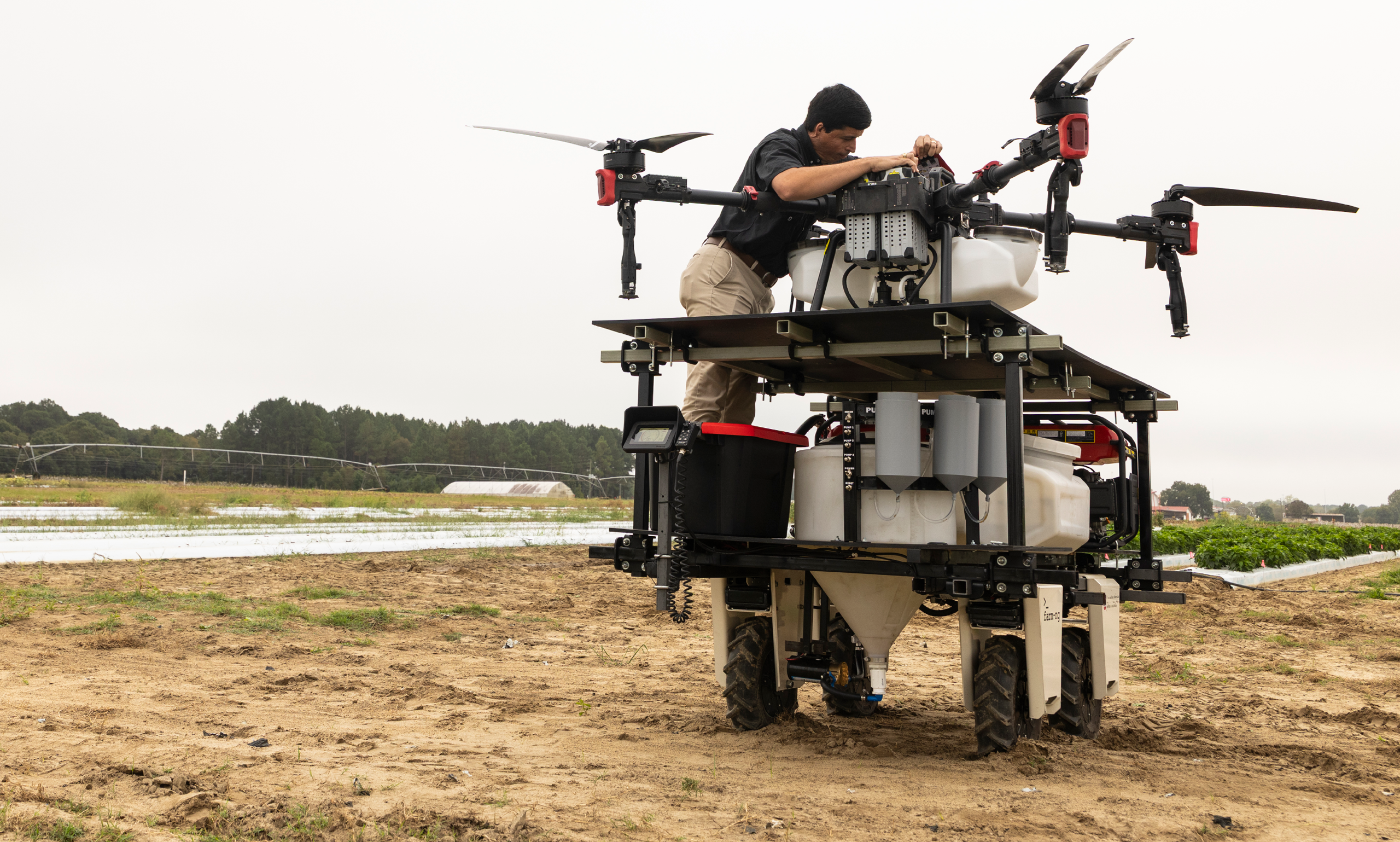
A man working on a large drone in a farm field.
A student holding a laptop computer with computer code on a screen in the background.
A student working at a desktop computer station, looking at the screen.

Connect With Us

Have a question or want to share AI-related news and events? We’d love to hear from you!

Get in Touch